 비전 아포코리아
Field story · Embassy legalization
Under autumn light, we walk the long road of embassy legalization for you

Ginkgo leaves have settled in gold along the streets, and the breeze carries the scent of the season. While the view outside deepens, another journey begins on the desks of Vision ApoKorea: the journey of a single document leaving Seoul for its place across the sea, along the road of embassy legalization to a country where an apostille does not work.
At a glance
- Documents for countries that have not joined the Apostille Convention need embassy legalization (consular legalization).
- Private documents prepared by a company pass through a chain of authentication: notarization → consular confirmation by the Overseas Koreans Agency → legalization by the foreign mission in Korea.
- This autumn, a quality certificate from a mid-sized Korean manufacturer followed this road all the way to legalization by the Taipei Mission in Korea.

Documents need a 'passport' too
A document made in Korea cannot prove its own validity once it crosses a border. That is why documents need a passport of their own.
If the destination is a Convention country, a single apostille is enough. For countries outside the Apostille Convention, the story changes. You have to complete embassy legalization, linking the confirmations of several authorities one step at a time, the so-called chain of authentication, before the document is accepted abroad.
It sounds simple, but if one link slips, you go back to the start. Different required documents for every country, different filing hours for every mission, a schedule that runs from one office to the next. For a first-timer, it is easy to make the trip again and again. We walk that road for you.
"You simply hand us the document.
We carry it the rest of the way."
This journey: Korean technology, bound for Taipei
This autumn we were entrusted with sending a quality certificate from a mid-sized Korean company to Taiwan. Taiwan is not a party to the Apostille Convention, which makes it a typical case for embassy legalization. In Korea, the Taipei Mission in Korea acts as Taiwan's mission.
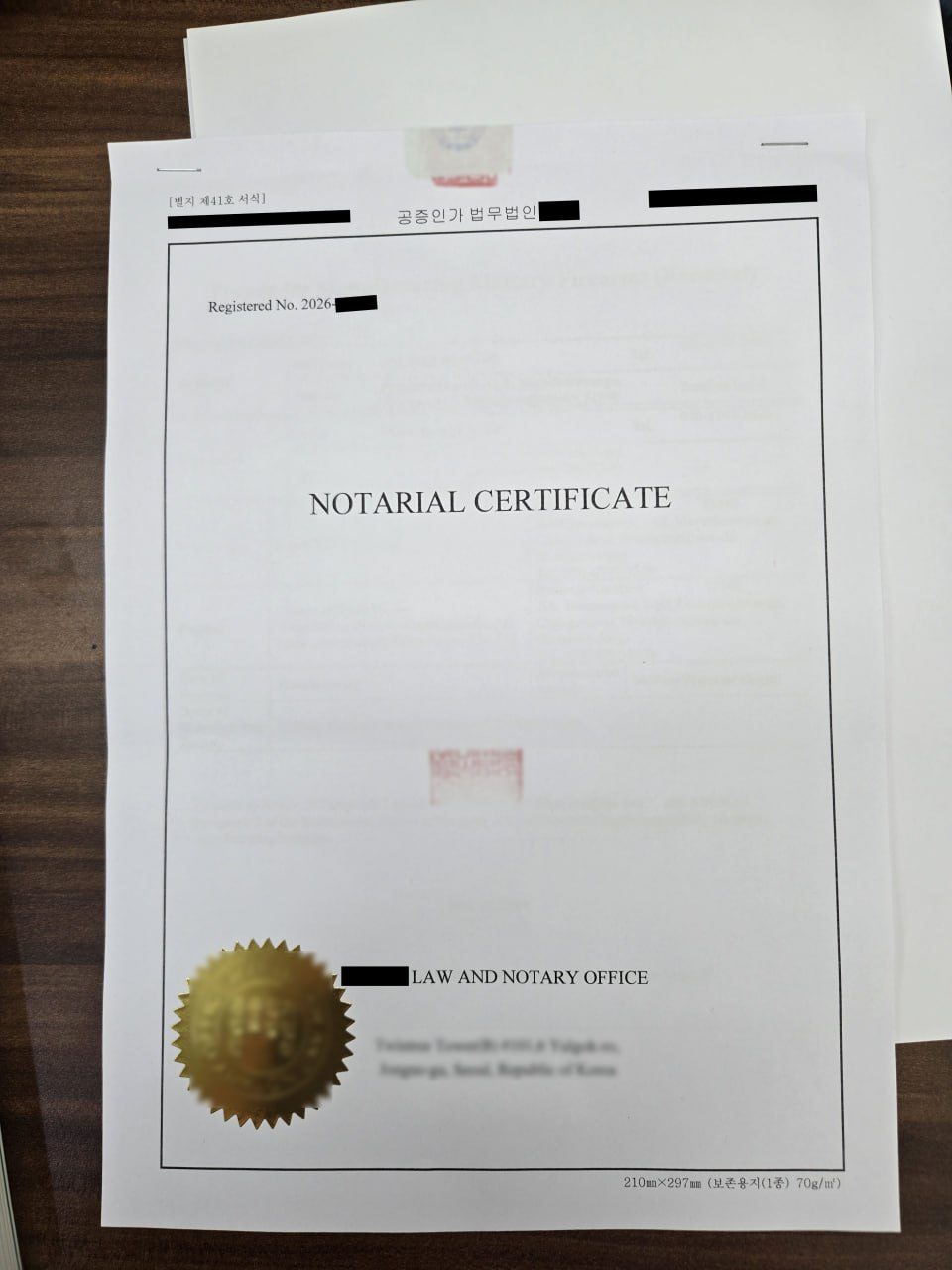
First gate · Notarization
A quality certificate drafted by the company itself is a private document. To carry public weight, it first needs a notary's confirmation. A notary law office confirmed the signature and the fact of its drafting, and the result was a notarized document bound together with a Notarial Certificate and a gold seal.
The registration number and law office details in the photo have been masked.
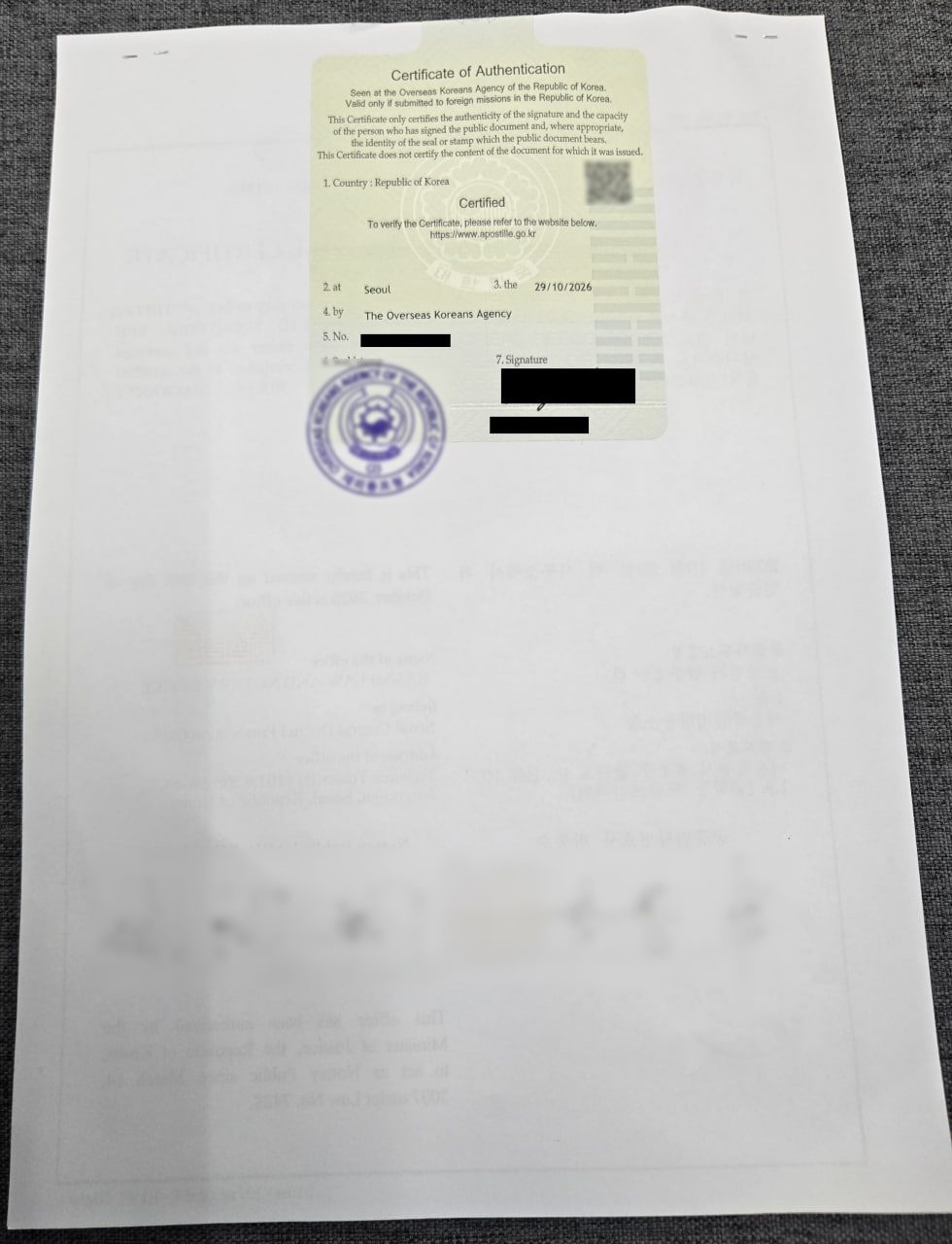
Second gate · Consular confirmation by the Overseas Koreans Agency
At this step the Korean government confirms that the notarized document was lawfully made in Korea. The Certificate of Authentication attached by the Overseas Koreans Agency states that it is "valid only if submitted to foreign missions in the Republic of Korea". It is the bridge to embassy legalization.
The certificate number and signature have been masked.

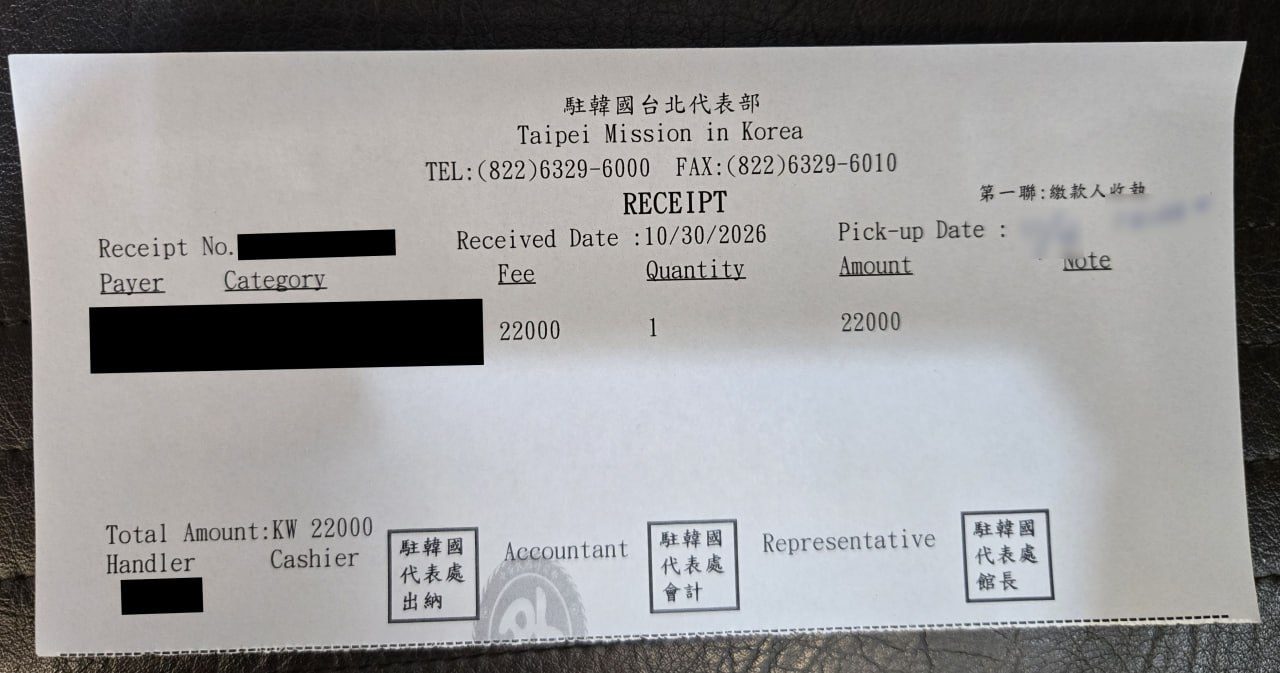
Final gate · Legalization by the Taipei Mission in Korea
With both gates behind it, we brought the document to the Taipei Mission in Korea in Gwanghwamun. The moment the mission's legalization is added, the document is ready to do its job in Taiwan.
Notarization → Overseas Koreans Agency consular confirmation → Taipei Mission in Korea legalization
Three gates, three different authorities. We took care of the order and the paperwork that connect them.
Why leave embassy legalization to specialists?
With embassy legalization, the order of the steps and what you bring matter more than where you go.
What Vision ApoKorea maps out first
- Whether the destination is an apostille country or one that requires embassy legalization
- Whether it is a public or a private document (a private document starts with notarization)
- Whether a notarized translation is needed, and at which step to attach it
- A full schedule that fits each mission's filing hours and processing time
Because we map out these scenarios the moment we receive a document, we can turn several trips of yours into a single hand-off.
Easy, fast and precise. The harder the task, the more care we take.

This autumn, leave the document's journey to us
As the leaves deepen in color, enjoy the season. Embassy legalization for non-apostille countries, or a procedure you are facing for the first time: Vision ApoKorea will take care of it in one flow, from notarization to the final legalization.
If you are not sure where a document's long journey should begin, feel free to contact us.
Need to submit a document to a country where apostilles do not apply?
Tell us the destination country and the document type, and we will guide you through the embassy legalization route.
Frequently asked questions
- How is embassy legalization different from an apostille?
- An apostille is a simplified system that lets Convention countries finish with one confirmation. Embassy legalization is used for countries outside the Convention: after consular confirmation by the Korean government, the document receives one more legalization from that country's mission in Korea.
- Can documents for Taiwan be apostilled?
- No. Taiwan is not a party to the Apostille Convention, so documents receive consular confirmation from the Overseas Koreans Agency and then legalization by the Taipei Mission in Korea.
- Why do company documents start with notarization?
- Because a document drafted by a company is a private document. Once it has been notarized, it can receive consular confirmation from the Overseas Koreans Agency.
- Where is consular confirmation issued?
- At the Overseas Koreans Agency (Overseas Koreans Service Center). The certificate states that it is valid only when submitted to foreign missions in Korea.
Official referencesOverseas Koreans Agency: consular confirmation procedure · Overseas Koreans Agency: overview of apostille and consular confirmation · Taipei Mission in Korea
⚠️ This article is for general information only. The authentication route, eligible documents and fees may differ depending on the nature of the document, the receiving authority and official guidance, so please check the official guidance of the Overseas Koreans Agency, the foreign mission in Korea and the receiving authority at the time you apply. Vision ApoKorea (Vision Administrative Office) is a private agency, not a government body.